
Independent chess preparation
Preparationchanges the gamebefore move one.
We turn game evidence into an opponent forecast, a tested opening choice and a brief the player can use at the board. Built for grandmasters, coaches, national teams and serious tournament work.
One federation per agreed period. One individual player per tournament. Confidential by design.
- 01Scout the opponentRepertoire and habits
1. d4 Nf6 2. c4 e6 - 02Choose the battlefieldThe opening decision
3. Nc3 Bb4 4. Qc2 - 03Validate the lineEngine and human checks
4... O-O 5. a3 Bxc3+ 6. Qxc3 - 04Brief the playerA file for the board
6... d5 7. Nf3 dxc4
01ExperienceThe work is already
The work is already
at the board.
During the 46th Chess Olympiad in Samarkand, we collaborated with one national team.
We keep the team unnamed because preparation relationships are private. This is a statement of collaboration, not a claim about competitive results or an endorsement by the team or FIDE.
Six months through October 202602What we doFour kinds of work.
Four kinds of work.
One preparation system.
Every project starts with a decision to support. We do not send a database dump and call it preparation. We find the likely position, test the risks and make the result usable for the person who plays.
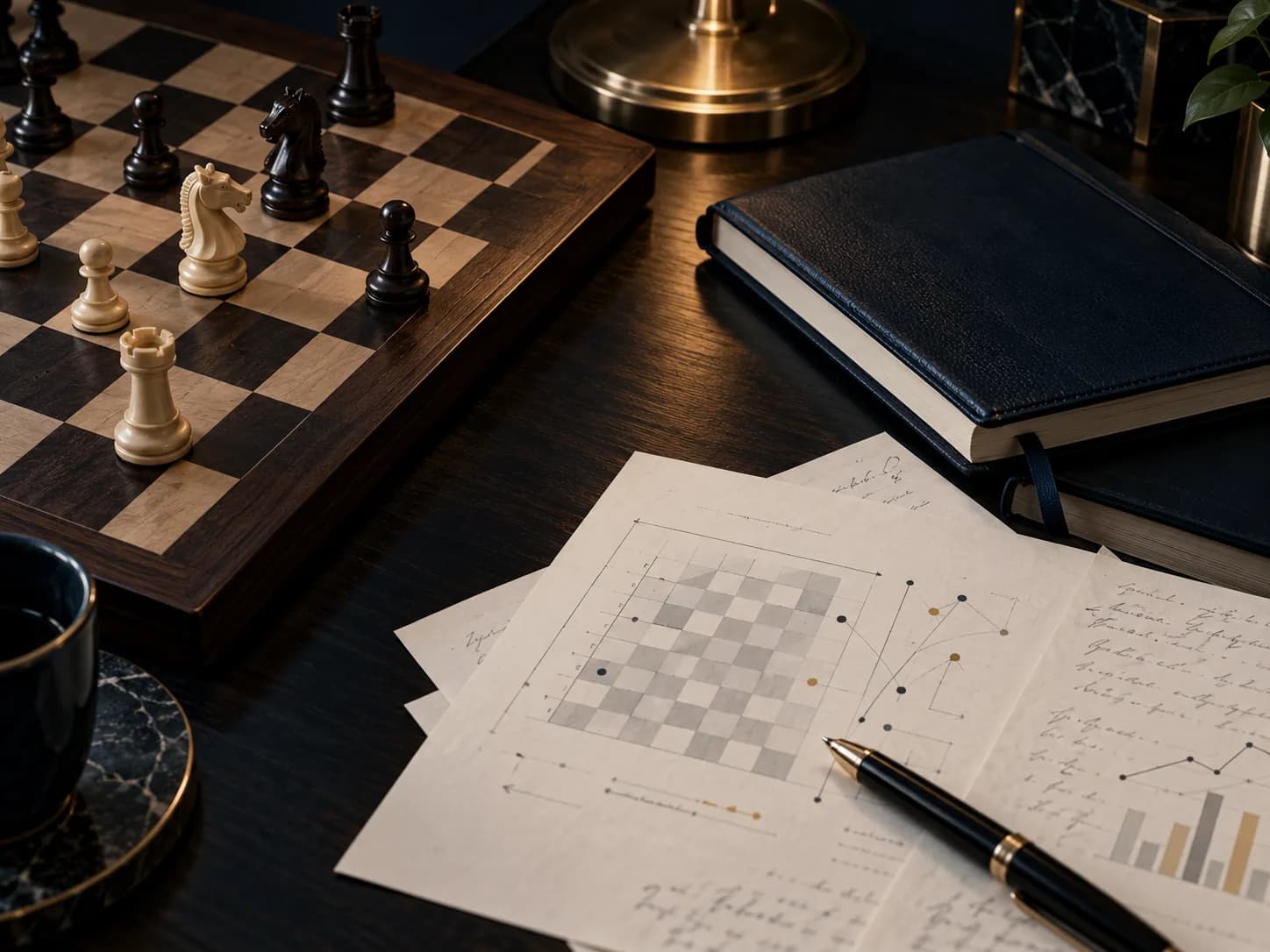
Opening explorer · opponent sample
Illustrative · no client data
| Bb4 | 62% | |
| d5 | 21% | |
| c5 | 9% | |
| b6 | 8% |
01 Service
Opponent Intelligence
A useful opponent file is more than a collection of games. We examine repertoire frequency alongside recent changes, preferred structures, decisions in similar positions, and how the opponent adapts after a surprise or loss. Every forecast should carry its evidence and uncertainty.
The resultA focused opponent brief that helps the player and coach decide where to spend preparation time.
Explore the work 
Candidate paths · ranked
- 4. Qc2★★★Fits repertoire
- 4. e3★★★Solid backup
- 4. Nf3★★★Transposes
02 Service
Opening Preparation
The top engine move is not automatically the best tournament choice. We compare candidate lines for theoretical soundness, player fit, opponent likelihood, practical complexity, and learning cost. The final path should remain playable when the opponent leaves the main line.
The resultOpening choices and files that make the next training session more decisive.
Explore the work 
Move-choice hypothesisHeld-out check pending · research stageIllustrative · no client data
03 Research-stage
AI Player Modeling
Player modeling is a research capability. It can surface hypotheses about move choice and style, but no model should be treated as a reliable substitute for a human opponent without task-specific validation.
The resultA transparent research assessment, with clear limits on what the model can and cannot support.
Explore the work 
Event rhythm · rounds 1–9
R1scoutedR2scoutedR3briefedR4playedR5reviewedR6reviewedR7playedR8briefedR9scouted
Illustrative · no client data04 Service
Tournament Preparation & Support
Tournament preparation changes quickly. We set the mission for each round, account for the player’s time and energy, compress the analysis into a usable briefing, and assess the preparation after the game independently of the result.
The resultA practical preparation rhythm that supports decisions throughout an event.
Explore the work 
03 · The methodA good line is
A good line is
only the beginning.
Preparation starts with the match goal, color, time and player. It moves through opponent evidence and technical checks, then ends with a concise player briefing and a post-game review. The result is judged separately from the quality of the preparation.
The seven-stage frameworkThe question is never only“What does the engine say?”It is also“What can this player use?”
04From mission to reviewSeven decisions.
Seven decisions.
One usable brief.
A repeatable framework that lets the analyst, coach and player know what has been checked, what remains uncertain and what matters before the round.
Stage 01 / 07Before the database: goal, colour, time.
- 01
Define the mission
Set the result goal, color, time budget, and player’s needs before opening a database.
- 02
Know your player
Map repertoire, familiar structures, practical strengths, and preferred information load.
- 03
Scout the opponent
Study recent games, likely responses, decision patterns, and the strength of the evidence.
- 04
Choose the battlefield
Compare candidate openings for soundness, player fit, opponent likelihood, and learning cost.
- 05
Validate the lines
Test best defense, deviations, tactical risk, human plans, and counter-preparation.
- 06
Brief and rehearse
Compress the work into a player-ready file and test recall of plans, not only moves.
- 07
Review the game
Assess the preparation separately from the result, then update the next opponent and player files.
05What reaches the playerResearch has to
Research has to
survive the handoff.
One project may produce three distinct layers. The analyst needs the full evidence; the player needs the important lines and plans; the final rehearsal checks decisions under time pressure.
01 / 03Complete research
Analyst Master File
Candidate lines, alternatives, sources, evaluations, and risk notes for the analyst and coach.
02 / 03Decision-ready
Player Preparation File
The lines, critical positions, ideas, and likely deviations the player can realistically review.
03 / 03Ready to play
Final Recall Check
A short rehearsal that checks understanding of plans and decisions, not only memorized moves.
Match-specificFor the next opponent
A focused brief for a known color, result goal and preparation window.
Long-termFor the season ahead
Develop and retain opening ideas that can be adapted when the next opponent becomes known.
06The peopleFive people.
Five people.
One preparation team.
From game collection and AI research to grandmaster direction, player training and controlled delivery, every role has a place in the final brief.
01 / 05
AI engineering · chess research
Alireza Karkon
Founder & Head of AnalysisAuthor of a 2026 preprint on human-centered chess move classification.
02 / 05
Grandmaster · competitive direction
GM Masoud Mosaddeghpour
Chess DirectorFIDE Grandmaster, player ID 12519278.
03 / 05
Federation coach · player preparation
Mohsen Mosaddeghpour
Training & MethodologyListed as a Grade 1 chess coach in a federation training announcement.
04 / 05
Information custody · delivery operations
Aida Fonouni
Operations & CoordinationCoordinates controlled access to project files and preparation outputs.
05 / 05
Game collection · research pipeline
Shayan Zarfeshan
Data & Research AnalystCollects and organizes game records for opponent research.

07The conditions of trustNo divided loyalties.
No divided loyalties.
No exposed preparation.
Exclusivity and confidentiality are part of the service, not footnotes. We agree the competitive boundary and information handling before analysis starts.
No divided loyalties
We accept one federation engagement during an agreed exclusive period. For individual tournament work, we support one player in that competition. Potential overlaps are checked before a brief is accepted.
If an engagement would put us on both sides of the same competitive situation, we decline it. The exact scope, event and dates of exclusivity are agreed before research begins.Preparation stays private
Games supplied privately, opening ideas, opponent files, model outputs and preparation decisions are treated as confidential client material.
We agree who may access a file, how it is shared, and when it should be retained or removed. No identifiable client work appears in a case study or public portfolio without permission.Evidence before certainty
A prediction is labelled with its evidence, sample size, recency and uncertainty. Engine checks, human approval and player rehearsal are separate states.
AI player models remain a research capability. We test them on held-out games and explain their limits before using any output to influence a practical decision.08Start the conversationThe next game
The next game
has a context.
Tell us the event, opponent, color, timing and the decision you need help making. We first check availability and conflicts. Please keep private game files out of the first message.
Client names, unpublished lines and supplied games stay private unless disclosure is explicitly agreed.